

After the University
A conversation with Chad Wellmon about institutions, disciplined study, and the future of higher education

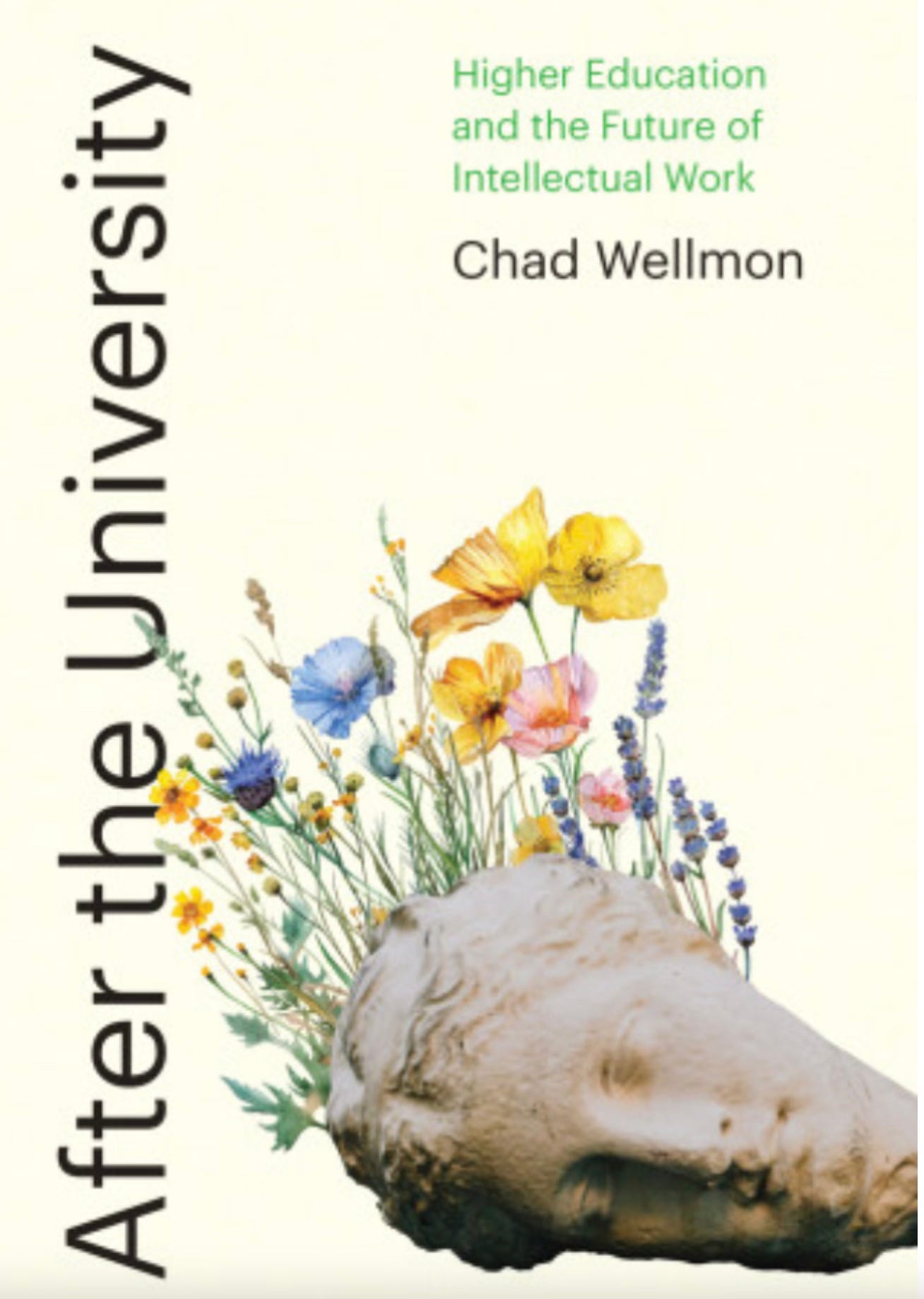
I have known Chad Wellmon for more than a decade and have long admired his refusal to accept familiar assumptions about higher education. Chad is a professor at the University of Virginia and a scholar of intellectual history and the modern research university. He recently joined a conference I hosted on what universities are for and what education requires. Those questions also animate his new book, After the University: Higher Education and the Future of Intellectual Work.
Drawing on a wide historical range, the book argues that the central issue for higher education today is not simply institutional decline but the fate of “disciplined study”—sustained practices of attention, reading, and inquiry that universities have sometimes supported but never fully contained. Chad’s title does not predict the disappearance of universities but asks us to imagine intellectual life without assuming that the university is its natural or exclusive home.
JOHN INAZU: Let’s start with a basic question: Why this book?
CHAD WELLMON: Honestly, the book began autobiographically. It came out of what I had been doing at the University of Virginia for the past decade and how my relationship to the university, to the profession, and my vocation as a professor had changed.
I started thinking seriously about the university in 2012, around the time I got tenure. That summer, UVA’s president, Teresa Sullivan, was fired. I found myself protesting alongside faculty, staff, students, alumni, and people from the Charlottesville community.
We had signs and chants. It felt almost liturgical. We were all there without much doubt about what was happening. But I remember looking around and thinking: What exactly are we doing?
That was when I started to see the university for the first time. Until then, I had mostly taken it for granted.
JI: But it’s not as though you encountered the university for the first time in 2012. You had been an undergraduate, a graduate student, and a professor. So what did you think the university was before then?
CW: It was my path out of Shelby, North Carolina.
I left home at sixteen to attend the North Carolina School of Science and Mathematics, a public boarding school. That started a long process of moving away from and defining myself against the world I came from—my family, a particular religious upbringing, and what I understood at the time as its anti-intellectualism.
My parents did not have college degrees. We read the Bible, but we did not read the kinds of books I later encountered. So the university became the keystone of a redemptive arc: boarding school, college, graduate school, and then a faculty position at UVA. That path lifted me up and took me out, in all the positive and negative senses of that phrase.
I believed in the university because it worked for me. And I did not distinguish between its instrumental and intrinsic goods. I needed a job. I also loved reading. Then I discovered that I could get paid and have health insurance to keep reading and teaching.
JI: So the university was both a vocation and an escape route.
CW: Exactly. But I did not know enough to distinguish those things.
I also had a very simple sociology for my family. According to the American logic of success, the reason my parents and most of my siblings had struggled was that they did not have college degrees. The reason I had succeeded was that I did. That was basically my evidence. The university had worked for me. So I defended both the institution and the idealized version of it that I carried around in my head.
JI: And one reason that story works until 2012 is that you were basically a consumer of the university. You received the goods without having to confront any of the costs or downsides.
CW: One hundred percent.
JI: There’s a counterfactual version of your life where you get tenure, avoid academic service, keep writing books, teach your classes, and never worry about any of this. You get out of Shelby, read for a living, and everyone lives happily ever after.
CW: Yes. And the institution probably would have rewarded me just as much—maybe more—financially and materially.
This book is partly an attempt to understand why I began wanting to become the kind of person who was committed to an institution. That desire did not come naturally to me. It still does not. But after 2012, and then over the next several years, I started to think more about the university as an institution.
JI: What changed?
CW: Well, first I spent seven years helping redesign UVA’s general education curriculum. I assumed that if we could articulate what had gone wrong with general education, rebuild the curriculum, and recommit the faculty to it, we might revivify the university.
I was not completely naive. After all, it took seven years. But throughout that time I still thought the curriculum was the center of the institution of the university.
Then I became principal of Brown College, one of UVA’s residential colleges, and discovered what I sometimes call “the other university”: student affairs, residence life, career services, all the places where students actually spend a huge amount of their lives.
Before serving in the residential college, I had treated much of that world as extracurricular or administrative. But I came to learn it had a much more formative influence on students than I had understood. That realization upended a lot of what I thought I knew about university reform.
And then COVID happened.
So the book grew out of trying to understand this institution that had done so much for me but that I had not really seen.
JI: Are you an institutionalist now?
CW: I am an aspiring institutionalist.
I’m a good enough liberal to think we become free in and through institutions—in and through shared practices made real and durable. But writing this book clarified that the university itself is not finally what I am defending.
For a long time, I conflated the university with the intellectual goods it happened to house. I assumed that if I cared about reading, teaching, inquiry, and intellectual formation, then I had to defend the university in its present form.
I no longer think that.
My more primary commitment is to those practices and to the possibility of participating in them, sharing them, and carrying them forward. The university has cared for some of those practices for the past couple of centuries. In many ways, it is still materially hospitable to them. It gives us libraries, salaries, laboratories, students, and time.
But it has also become increasingly inhospitable to them.
JI: That sounds like a fairly significant shift. You thought you were writing a defense of the university and discovered that you were defending something else.
CW: Yes. Exactly.
And because my experience of those goods had occurred almost entirely through universities, I had assumed they were only possible there. I could not see the other places and forms in which they were alive—sometimes very much alive.
That was partly an autobiographical failure of imagination. I think back now to the example of my father. My father was an extraordinary Bible reader. He sat at the kitchen table with yellow legal pads, concordances, translations, and reference books. He was not getting paid. There was no prestige involved. He did it because he felt he had to.
For years, I could not recognize him as a model of intellectual virtue. I had defined myself against him. He was the uneducated, Bible-reading guy I had to leave behind.
But I eventually realized that he was my first model for what a reader was. We were different kinds of readers, but he was engaged in a serious intellectual practice.
JI: So does your father count as an example of the practice of “disciplined study,” or was he doing something adjacent to it? What are the minimum requirements of the practice?
CW: Disciplined study is more than private curiosity or reading books on your own. It involves practices shared among people over time: common objects of attention, habits, standards, responsibilities, and forms of accountability.
My father had some of that. He had texts, tools, and an interpretive tradition, even if he did not fully acknowledge his dependence on them. He thought he could bootstrap his way to truth by himself. But all those concordances and translations on the kitchen table existed because of traditions, communities, institutions, and the labor of many other people.
Disciplined study needs more than a committed individual. It needs some regularity, continuity, authority, and material support. In that broad sense, it needs institutions.
It does not necessarily need a modern university.
JI: This is where your argument starts to sound MacIntyrean. Healthy practices pursue internal goods, but institutions rely on external goods like money and power to survive. The practice needs the institution, and the institution threatens to corrupt the practice. Is that tension manageable, or is corruption built in from the beginning?
CW: That question haunts the whole book. And I do not have a clean answer.
The tension has always been there. The University of Paris in the thirteenth century faced pressure from the church about which of Aristotle’s works could be taught. The eighteenth-century University of Göttingen depended on a ruler who regarded it partly as a mercantilist enterprise and wanted tuition revenue from wealthy foreign students.
There was never a pure university devoted exclusively to the internal goods of study. Institutions have always required money, political authorization, and protection.
JI: So the standard decline narrative—there was once a more pure university devoted to truth, and then administrators, donors, politics, and capitalism ruined everything—is historically false.
CW: Completely false.
There was no golden age. The university has always been entangled with power.
But saying there was no golden age does not mean nothing has changed. The scale and structure of the modern university matter. Over the past two centuries, the tensions within the university have hardened into contradictions. The university began pursuing money and prestige not simply to support scholarly communities or satisfy the state, but to sustain and enlarge itself.
Once the structures and incentives become sufficiently powerful, the institution asks even virtuous people to spend most of their energy serving its own reproduction. You can have a good dean, a good president, or a group of committed faculty members. They may protect particular spaces for a time. But they are operating inside an institution that has its own interests—rankings, revenue, growth, prestige, political protection. Those interests have become embedded in the institution itself, and they change the institutional conditions for everyone who participates in it.
JI: Let me test the institutional argument with an example. I am part of a group of eight or nine law professors who have been reading and discussing your book on Zoom. Does that count as disciplined study? And what happens if someone gives us a billion dollars—enough to hire staff, create prestige, and sustain the group indefinitely? Have we become an institution, or have we ruined the practice?
CW: You may already be an institution. And you may be much better off without the billion dollars.
We have absorbed this idea that a good practice becomes legitimate only when it scales. We assume eight or nine people are not enough. It needs to become a national network, and then a larger organization, and then it needs staff, branding, assessment, and influence.
I now think that assumption is pernicious.
You have shared practices organized around a common time and common objects. Someone schedules the meetings. Someone chooses the reading. People accept obligations to one another. There are expectations about participation. That may be enough.
Think about baseball. Major League Baseball is one institution, but minor leagues, college teams, travel teams, and Little League teams all participate in the practice of baseball and comprise their own, sometimes several, institutions. We do not need one comprehensive institution that absorbs every local version of the game.
The university has so saturated our imagination that we have trouble seeing the many other forms through which intellectual practices have survived: monasteries, libraries, schools, museums, workshops, reading groups, and small communities.
Your group may already be practicing disciplined study. The billion dollars might make it more durable. But it might also burden the group with ambitions that have nothing to do with why you started meeting.
JI: The category of “the university” is doing a lot of work in our discussion. There are thousands of colleges and universities in the United States. Most of them are not research universities. Could smaller and less prestigious institutions be better homes for disciplined study?
CW: Possibly. But when I talk about “the university,” I often mean the system of American higher education, not just individual campuses.
Institutions exist relative to one another. The system ranks them, distributes prestige, and creates pressures to imitate the institutions above them.
A regional university or community college may look nothing like UVA. But it is still part of a larger system that defines what excellence, success, and institutional advancement look like.
In some cases, the pressure against disciplined study is even stronger in these institutions. Community colleges are frequently treated as sites of narrow job preparation. Their students are assumed to want credentials and employment, not liberal education or sustained intellectual inquiry.
The system effectively tells them: those goods are luxuries for other people.
JI: What alternatives do you see to the university?
CW: One example is the Catherine Project, founded by Zena Hitz. It organizes mostly online reading groups around great books led by trained facilitators. And the project is explicitly non-credentialing.
My oldest son recently joined a group reading Cormac McCarthy’s Blood Meridian. He is an engineer in Los Angeles. He was not an enthusiastic reader growing up, and now he meets every Friday with people from around the world to discuss a common text.
That tells us something. People want to read, think, and talk together without necessarily receiving a credential.
The Catherine Project is becoming an institution. But it is decentralized, and it is not directly tied to the labor market. That separation from credentialing is enormously liberating.
There are many small institutions trying to respond to that desire. None is a blueprint. But together they show how much intellectual longing exists outside the forms through which universities typically measure and monetize it.
JI: I want to press on the word “alternative.” Are these actually alternatives to universities, or are they supplements created by people whose education, status, and financial stability still depend on universities?
CW: That is a real problem. Many of these projects remain parasitic on the university in some sense. Their teachers were trained there. Their texts were preserved there. Their participants may have learned the relevant habits there.
We should not pretend we can simply walk away and start over.
But dependence does not mean identity. A practice may emerge from the university and still find a different institutional form. The question is whether these smaller communities can develop enough authority, continuity, memory, and material support to endure.
JI: Which historical traditions help you imagine that kind of endurance?
CW: The Christian tradition contains many examples, especially monastic communities organized around practices sustained over long periods of time. Those practices were directed toward ends beyond themselves, but those ends were embodied in daily forms of prayer, reading, study, work, and communal life.
The Black university tradition is another important example, especially in the late 1960s and 1970s. Its advocates were unusually candid about the uneasy relationship between intellectual work and political ends.
They understood that a community devoted only to protecting its internal practices could become blinkered. But they also asked whether Black intellectual life should remain within American higher education, transform it, or depart from it. That contested relationship to the larger system was at the center of the project.
JI: The Black university example is interesting because it represents a different kind of imagination within the institution of higher education. The monastic tradition and something like the Catherine Project stand at least partly outside it. What about religiously affiliated universities? Do their traditions give them resources that other universities lack, or is the modern institutional form simply too powerful?
CW: The Catholic tradition is full of examples, but so are the American denominational colleges that existed before the late nineteenth century.
There is no reason to romanticize those institutions. They had serious problems. But they often possessed an account of education whose purpose exceeded labor-market value, economic productivity, and graduate salaries. They could speak about forming a soul, a pastor, a citizen, or a particular kind of human being. That gave them an ethical and institutional logic for learning that was not entirely subordinate to money or state power.
Hillsdale is another example. Say what you want about Hillsdale, but its decision long ago to cut itself off from federal funding should at least make us pause and ask whether it was a good idea to turn American colleges and universities into something like federal contractors after World War II. Hillsdale preserved a degree of institutional independence that most universities no longer have.
JI: And the recent conflict between the Trump administration and universities exposed that dependence.
CW: The Trump administration understood exactly where the points of leverage were.
University presidents were often right to describe the administration’s actions as an assault on higher education. But their defenses of their institutions were also revealing. They talked about cancer research, scientific production, and human capital. They said almost nothing about education—about whether these institutions educate young people or shape the lives of the people who work in them. They defended outputs.
And that is striking because it is also the idiom in which the Trump administration operates: transactional, productive, and focused on measurable returns. The universities and the Trump administration oppose one another, but in some respects they speak the same language.
JI: Let’s come back to the title of your new book. When you say “after the university,” are you predicting that universities will disappear?
CW: No. Universities are not going anywhere. They are too wealthy, too powerful, and too useful. They will continue conducting scientific research, issuing credentials, and providing employment.
“After the university” is more about an intellectual and ethical condition. It means recognizing that the university is not identical with disciplined study and does not possess a monopoly over intellectual life.
Writing the book was strangely liberating. I thought the conclusion would be depressing. Instead, separating the practices I love from the institution that has housed them allowed me to see other possibilities.
really, really enjoyed this. thanks.
Good discussion!