

What Are We For?
Stephen West, Alasdair MacIntyre, and the difference between wisdom and expertise

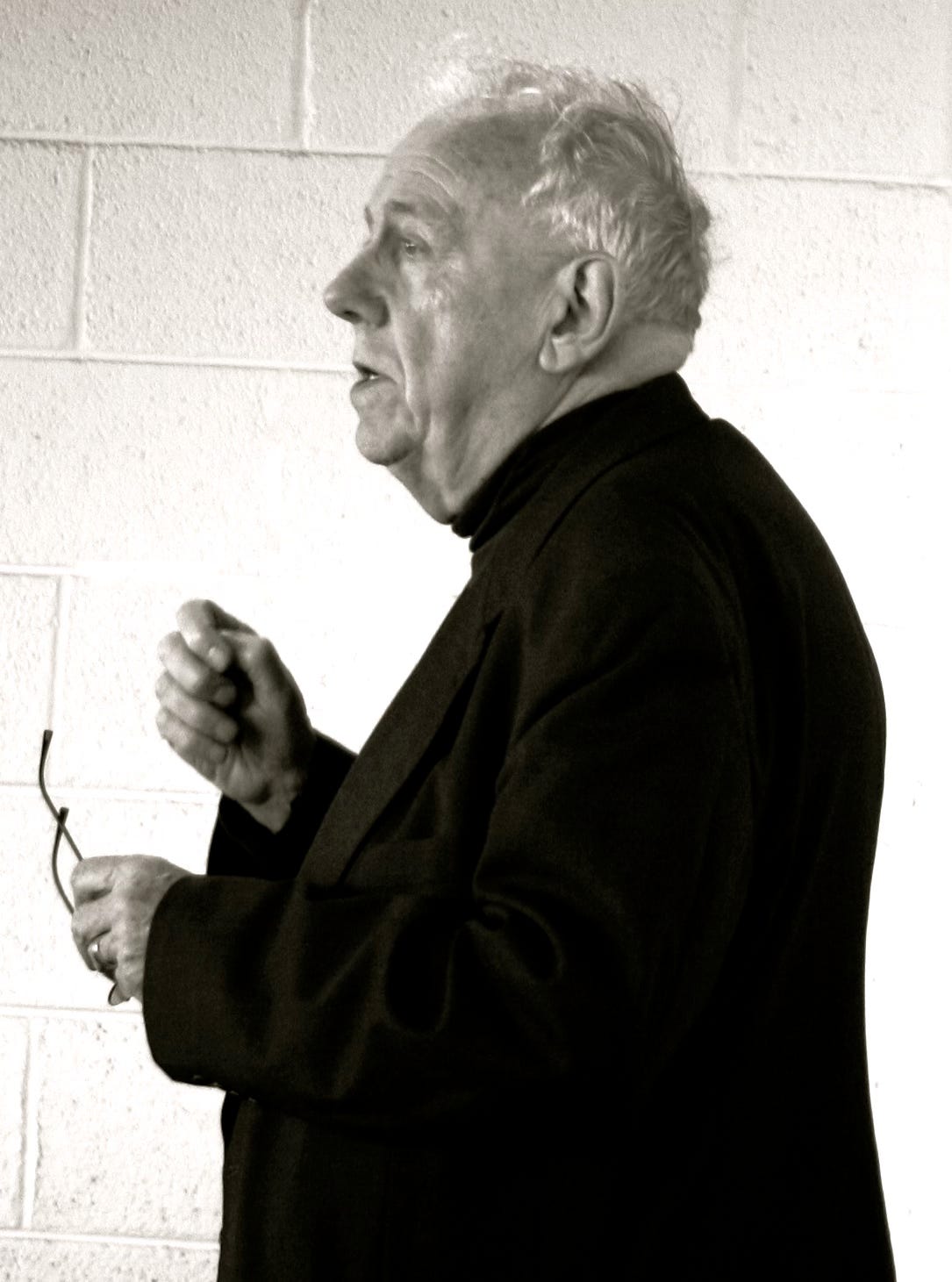
I owe my (just-graduated!) research assistant Perri Wilson a big thanks for introducing me to Stephen West’s podcast, Philosophize This. In particular, Perri alerted me to four recent episodes West devoted to the work of Alasdair MacIntyre.
As someone who has long been influenced by MacIntyre, I found West’s summaries clear, insightful, and engaging. I plan to use them as a bridge from MacIntyre to our classroom discussions:
Do the hard work of reading (at least some!) MacIntyre
Listen to West’s excellent podcast summaries to see if you are understanding the moves that MacIntyre is making
Come to class and think together about what MacIntyre is saying and why it matters to your life.
One of the reasons I want students to encounter MacIntyre is that he helps name a problem that now permeates our universities, professions, politics, and technologies: we have become very good at technique and very bad at explaining what our techniques are for. Our deficiencies begin when we fail to realize how we are shaped to live in and see the world.
There is no view from nowhere
MacIntyre insists that nobody reasons from nowhere. Not the religious person. Not the secular person. Not the scientist or the judge. Not the university administrator drafting the next missive about justice, diversity, or free speech.
We all reason from somewhere. We inherit languages, practices, institutions, loyalties, memories, wounds, hopes, and fears. We learn what counts as an argument, what counts as evidence, what counts as cruelty, what counts as courage, what counts as harm, what counts as freedom, and what counts as love. We do not simply discover these things as free-floating rational agents. We receive them, revise them, and sometimes reject them. But even our rejection comes from somewhere.
And our rejection also leads somewhere. As my friend Kavin Rowe has noted in his book, One True Life: The Stoics and Early Christians as Rival Traditions: “the human condition is such that you have to choose how to live from among options that rule one another out.” And we make those choices trusting in things unseen: “we wager our lives, one way or the other,” because “we cannot know ahead of the lives we live that the truth to which we devote ourselves is the truth worth devoting ourselves to.”
This is one of the reasons so many of our public arguments feel exhausting and futile. It is why we increasingly struggle to distinguish between facts, laws, and moral judgments. We imagine we are disagreeing only about conclusions when we are often disagreeing about the assumptions that make conclusions possible.
West explains MacIntyre’s three rival approaches to moral inquiry: the encyclopedic, the genealogical, and the tradition-based. The encyclopedic approach assumes that with enough information, conceptual clarity, and rational procedure, reasonable people will converge on the right answer. The genealogical approach suspects that moral claims often mask power, interest, or domination. The tradition-based approach, which MacIntyre endorses, begins with the recognition that moral reasoning always occurs within inherited practices and communities.
That does not mean all traditions are equally good. Traditions can be judged by whether they can explain the world, form virtuous people, confront their own failures, learn from rivals, and survive internal contradictions. But the way to judge a tradition is not to pretend we can step outside of it. It is to ask whether a tradition can tell the truth about the human beings we actually are. This matters a great deal for a pluralistic society.
We are dependent rational animals
One of MacIntyre’s most important later moves is describing human beings as “dependent rational animals.” We are rational, but our rationality is not self-generating. We become rational through dependence: through parents, teachers, friends, nurses, mentors, communities, institutions, and countless acts of care we did not earn and could not repay.
This is a direct challenge to one of the great myths of modern life, which suggests that the most flourishing human being is an autonomous individual who needs as little as possible from others. MacIntyre insists that dependence is not an embarrassing exception to the human condition. It is the human condition.
We all begin life dependent on others. Most of us will end life either suddenly and without warning or dependent on others. Between those two points, we experience illness, confusion, grief, weakness, disability, failure, and need. Even our moments of apparent strength are sustained by social arrangements we rarely notice: the person who taught us to read, the neighbor who showed up, the colleague who told us the truth, the doctor who listened, the friend who forgave, the family member who stayed.
For MacIntyre, the basic unit of moral life is not the isolated individual making rational contracts from a position of strength. It is what he calls networks of giving and receiving. Moral life depends on relationships in which the needs of others are sufficient reason for action, not merely occasions for contract, exchange, or rights-claiming.
This has obvious implications for politics. A society cannot be judged only by the wealth of its strongest members, the efficiency of its markets, the credentials of its elites, or the sophistication of its technologies. It must also be judged by whether children, the elderly, the sick, the disabled, the lonely, the poor, and the socially inconvenient can exist as members rather than burdens.
Universities neglect our formation and our dependence
MacIntyre believes the university often produces the kind of person who fails to realize that there is no view from nowhere and who ignores or downplays his dependence on others.
That may not sound terribly deficient, but its implications are far-reaching. For MacIntyre, the university is good at producing expertise, but it is much less good at cultivating wisdom. It produces experts who know their field but not always what their work means. It produces graduates who have not learned to ask the right questions.
As West notes, MacIntyre draws from John Henry Newman’s The Idea of a University for “the understanding that receiving an education at the highest level should be doing your work in consideration of a number of deeper questions that are just bracketed off in the modern university.”
These are questions like:
What kind of person am I becoming?
What goods are internal to the work I am doing?
What forms of excellence should I pursue?
What temptations are built into this profession?
Whose suffering am I trained not to see?
What do I owe to the communities that made my life possible?
West’s summary of MacIntyre’s reading of Newman is especially helpful here. A university, on this account, is not merely a place that transmits technical competence. It is supposed to help students ask what their knowledge is for, what kinds of people they are, and what forms of truth their disciplines disclose or obscure.
West draws out one of MacIntyre’s deeper points:
Every institution is built and organized on top of answers that are assumed to these fundamental questions. And our institutions are this way even when the people living in them pretend like they are value neutral, and even when the institution itself claims to not have set answers to these questions.
And imagine if this was the blind spot of the place that gave you your education on the world. It would no doubt produce people that are experts in their field. . . . Consider how possible it is for someone to become world class at manipulating one little slice of reality, while simultaneously becoming worse at understanding what their job means inside a life or a society.
That indictment encompasses a lot of doctors and lawyers. Which brings me to the professions.
Professions like medicine and law are especially impoverished by the failure of the university
Several years ago, I was honored to speak to a gathering of doctors and senior administrators at the Mayo Clinic. My topic was “Contemporary Challenges to Professionalism: The importance of organizational purpose, values, and mission.” As I noted in my remarks:
Most doctors and lawyers I know—and most students aspiring to those professions—are drawn to these career fields because of their desire to help people and help society. At their healthiest, law and medicine play vital roles in peacekeeping and healing. But when they lose their sense of purpose—their true north—both disciplines can quickly become deflating and disorienting.
I didn’t name MacIntyre in my comments at the Mayo Clinic, but his influence was underneath most of the argument I was making.
West picks up on a similar observation about modern medicine:
Notice how easy it is for the doctor in this scenario to be a total expert when it comes to medicine, a technical skill, but be completely oblivious to the moral foundations that their shared practice of medicine is steeped in, to be removed from the reasons why it’s important to us to have people studying medicine at all.
In contrast:
We want somebody who can judge what that diagnosis means in the life of this real person who’s standing in front of me. Someone who gets that this is more than just about reading test results or protecting themselves legally. Someone who gets that they’re dealing with a human being here where certain ends matter to them in their life.
A good doctor is not simply a body mechanic with access to advanced instruments. A good doctor must know bodies and people, protocols and judgment. She must know when to intervene, when to wait, when to speak plainly, when to sit quietly, when to hope, and when not to lie.
That kind of judgment cannot be reduced to technique.
Law is similar. A good lawyer is not merely a technician of rules, risks, and leverage. A good lawyer must know the law, but he must also know the goods the law serves and the harms the law inflicts. She must know how to win, but also when winning is not the highest good.
Law schools are not especially good at this kind of formation. We are good at teaching students to spot issues, parse doctrine, construct arguments, and anticipate counterarguments. Those are real skills, and they matter. But if we teach those skills without asking what kind of person should use them, and for what ends, then we have formed technicians more than practitioners.
Every profession has external goods: money, prestige, influence, status, institutional power. Those goods are not necessarily bad. But when they become the point of the profession, they corrupt the practice from within.
MacIntyre helps us see why this happens. Practices require institutions, and institutions require resources. But institutions also tempt us to exchange internal goods for external goods. The internal goods of law include judgment, fidelity, advocacy, order, mercy, and the disciplined use of power. The internal goods of medicine include healing, care, truth-telling, presence, and the wise treatment of embodied vulnerability. These goods can survive only if communities of practice name them, teach them, and protect them.
That is why professional formation cannot be outsourced to ethics modules, professionalism pledges, or compliance trainings. Those may have their place, but they cannot do the deeper work of formation. That work requires communities, exemplars, and time to practice.
Final Thoughts
West concludes his fourth and final episode on MacIntyre by naming the question MacIntyre across his work invites us to keep asking:
What sort of a world would we have to build for dependent, rational animals like us, who are shaped by traditions, to become wise enough to see what we’re doing, and moral enough to continue doing it together?
That question belongs in our classrooms, our hospitals, and our courtrooms. And as West emphasizes throughout his podcasts, it is not only an academic question but a practical challenge for all of us.
Here are Stephen West’s four episodes on MacIntyre:
Episode 244: After Virtue: Why Moral Conversations Feel Unsatisfying (discussing After Virtue)
Episode 245: The Rival Approaches of the Modern World (discussing Three Rival Versions of Moral Enquiry)
Episode 246: The Myth of the Self-Made Person (discussing Dependent, Rational Animals)
Episode 247: The Failure of the Modern University (discussing The Task of Philosophy and God, Philosophy, Universities: A Selective History of the Catholic Philosophical Tradition)
Thanks for tipping me off to that podcast. I look forward to checking out these episodes.
Thank you, John. This takes me back to my undergrad in Education and much time that was spent evaluating various educational theorists and world views using a model by William Frankena. You may be familiar - but here’s a short AI summary:
Structure of the Frankena Model:
The model is structurally organized as five logically interconnected domains, commonly referred to as "boxes".
Box A: Ultimate Purpose (Normative): This represents the fundamental, overarching goal of humanity or life. It establishes why education takes place (e.g., to achieve spiritual salvation, to serve democratic citizenship, or to achieve personal autonomy).
Box B: Premises about Human Nature (Factual): This encompasses empirical, philosophical, or psychological truths regarding human life, culture, and the world. It outlines the current state, constraints, and realities of the learners.
Box C: Desired Excellences (Normative Conclusion): Born from the interplay of Boxes A and B, this specifies the exact traits, knowledge, values, and skills that need to be produced within the student to bridge their human nature with their ultimate purpose.
Box D: Theories of Learning (Factual): This identifies the specific mechanisms of how people learn, change, and adopt the dispositions outlined in Box C. It draws heavily from psychology and educational research (e.g., experiential learning, cognitive development).
Box E: Practical Methodology (Practical Conclusion): The final step outlines the actionable teaching methods, curricula, and instructional strategies required to activate the learning theories (Box D) and foster the desired excellences (Box C)