

'Tis the Season
Merry Christmas, Happy New Year, and a few reading recommendations


I had planned to finish the year with more regular posts on Some Assembly Required, in addition to working on a number of other fun projects. Instead, I lifted a heavy table the wrong way.
Following a successful surgery last week, I am in the contraption pictured above for the next 5-10 weeks. That means basically no functionality of my dominant arm. There is suddenly a lot I can’t do as quickly, and plenty that I can’t do at all.
Given my limited bandwidth and typing ability, I’m passing along three reading recommendations as we close out the year. I didn’t set out with a unifying theme, but these three recommendations ended up circling the same concern from different angles. Each, in its own way, examines systems built on speed, prestige, and amplification—and asks what those systems do to our habits, our institutions, and our sense of responsibility.
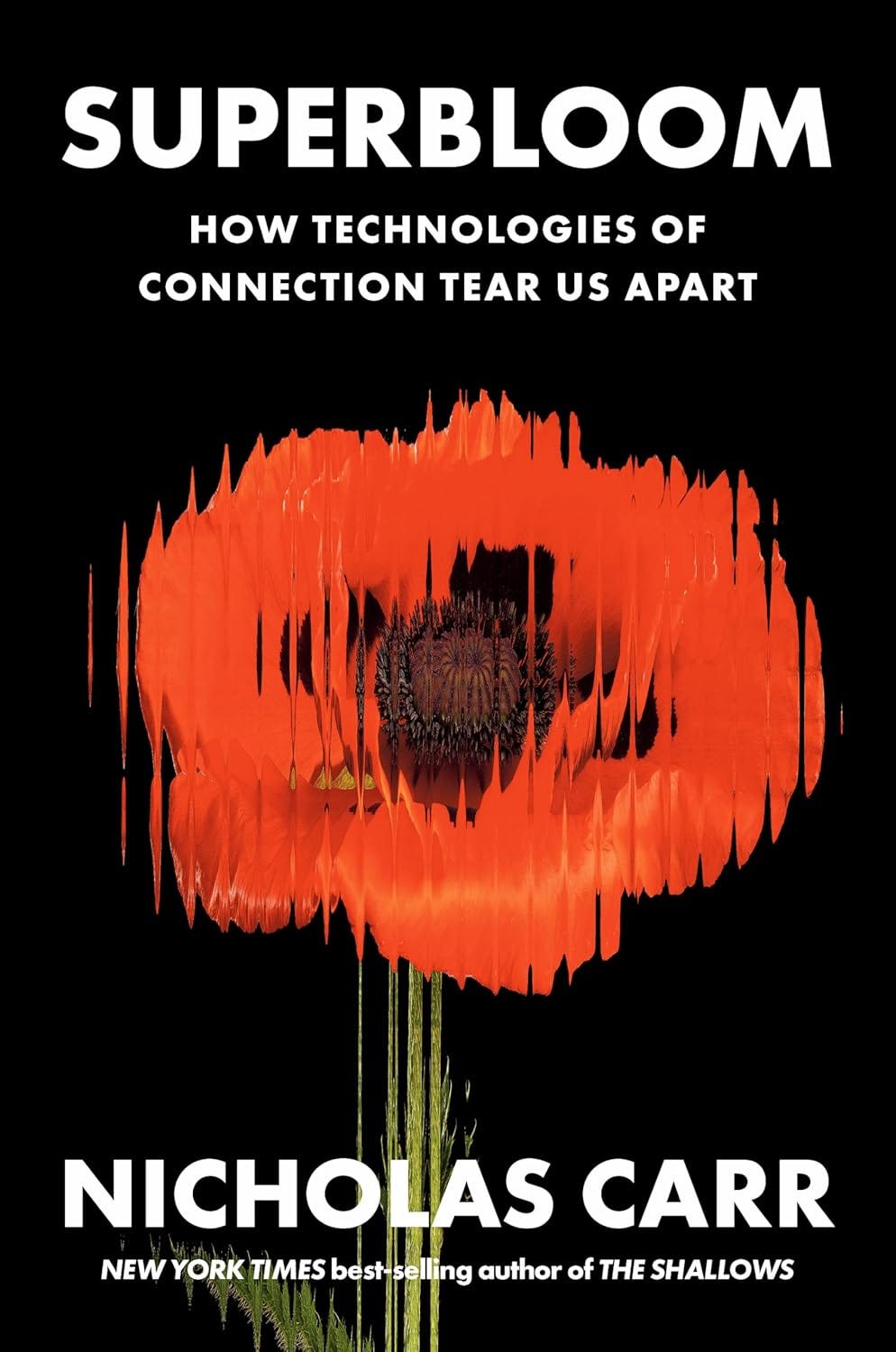
Nicolas Carr, Superbloom: How Technologies of Connection Tear Us Apart
Carr’s book is the clearest diagnosis I’ve read of the technological conditions shaping how we think, argue, and relate to one another. Carr is best known for his 2010 book, The Shallows, an exploration of how the internet is rewiring our brains. Superbloom is broader and, in some ways, darker. As one friend suggested to me, an alternate title could have been Superbloom: I told you so fifteen years ago but you didn’t listen.
Carr traces the long arc of communication technology from the telegraph to today’s AI-driven platforms, showing how each wave promised new forms of connection and delivered some—but also came with costs we didn’t see, or didn’t want to see. His central argument is that our tools have become too frictionless, too fast, and too ubiquitous. They flood us with communication that isn’t actually conversation, information that isn’t wisdom, and connection that isn’t community. Constant messaging, algorithm-shaped feeds, and AI-generated content give us the impression of being connected to others when in fact we’re losing the skills, patience, and presence that make real relationships possible.
If we continue to replace embodied practices with digital substitutes because they’re easier, cheaper, or more scalable, we shouldn’t be surprised when the virtues those practices once cultivated begin to disappear. Universities, churches, workplaces, and civic groups cannot outsource formation to platforms without quietly redefining what kind of people they are trying to produce. Assembling, it turns out, is not just about logistics. It’s about the slow work of learning how to be with other people.
Evan Mandery, Poison Ivy: How Elite Colleges Divide Us
Mandery shifts the focus from technology to educational institutions. He argues that “Ivy-plus” schools (the Ivies and other elite schools) function less like ladders of mobility and more like engines of inequality—especially when paired with affluent suburban and private school systems that effectively serve as feeder pipelines. His core claim is structural: elite colleges publicly celebrate access and diversity, but privately depend on admissions pathways and “merit” signals (school quality, extracurricular packaging, counseling ecosystems, test prep classes) that are disproportionately available to wealthy families—producing de facto segregation and reinforcing income stratification. Even most college athletics play into this system in ways that were completely off my radar until I read his book.
I have lived most of my adult life in and around the schools Mandery critiques. And I have to say, I find his arguments almost entirely convincing. Worse still, elite colleges are not merely passive mirrors of inequality but active producers of it. They do not just sort talent; they shape aspiration. Through what they celebrate, fund, and quietly normalize, they teach students which lives count as serious and which do not. When a disproportionate share of graduates funnel into management consulting and adjacent prestige professions, that is not an accidental byproduct of “student choice.” It is the predictable outcome of institutional signals about status, success, and worth.

Gabe Fleisher, Wake Up to Politics
This last recommendation isn’t a book, it’s a daily Substack (which I have previously recommended). Fleisher offers something different than Carr or Mandery—not diagnosis, but an example of how to do things better. He shows what it looks like to practice seriousness and care inside a media ecosystem fueled by shallowness and speed. If you care at all about understanding politics and government as a citizen rather than a spectator or a rage baiter, you should be reading Gabe Fleisher. (If you want a sample, read his recent post on Susie Wiles’s Vanity Fair interview.)

Carr and Mandery diagnose systems that reward speed, prestige, and amplification. Fleisher models what it looks like to resist those pressures from the inside. His work shows that seriousness, restraint, and civic responsibility are still possible, but only through deliberate practices that run against the grain.
If you’re reading this post, you are among a uniquely privileged group in human history: you have access to some electronic device, you are literate, and you are at least moderately interested in the kinds of topics I’ve been discussing here. That privilege carries responsibility. One small place to start is by ruthlessly examining our media sources, cutting out as much garbage as we can (which probably includes most of what we’re scrolling rather than reading), and focusing our time and energy deepening our understanding of the world around us with the people we encounter.
See you next year!
You did well at what I presume was dictating this substack!!
John... Merry Christmas. So sad to see your arm in that contraption! Wishing you a full recovery. Thank you for the reading recommendations ... interesting the theme that emerged - ' the no free lunch' cliche never goes away. In our race for technologies that are supposedly going to give us more time to be artistic, knowledgeable, creative and connected many find themselves making cat videos and hunched over screens - friendless and obsessing over the the most shallow aspects of human life. I know to state these things make me a curmudgeonly luddite but the reality that has been created can no longer handwave concerns away. Go for a walk, dance, read a book, sing... make technology use a choice not a default.